
Why Change Orders Keep Hurting Your Project Margins
Late change orders quietly drain project margin. See how paperwork piles up, what a documented change order includes, and how...
Read More → 
AI-powered dashboards highlight key trends instantly and turn complex project data into clear, actionable insights.
Request a demo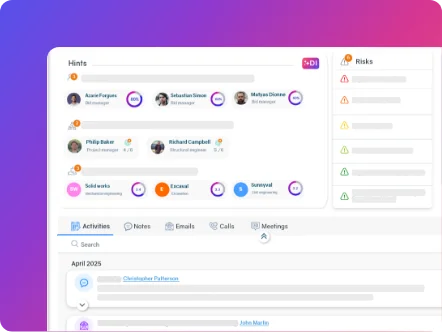
AI-powered dashboards highlight key trends instantly and turn complex project data into clear, actionable insights.

AI-powered dashboards highlight key trends instantly and turn complex project data into clear, actionable insights.
Request a demoAI-powered dashboards highlight key trends instantly and turn complex project data into clear, actionable insights.
The project closes out and the final account lands well short of the number in the tender. Nobody made one bad call. The margin leaked away a little at a time, in places no one was watching.
General contractors, specialty contractors, engineering consultancies and other project-based businesses consistently deliver solid work while watching their margins shrink between tender and final account. It’s one of the most persistent financial problems in project-based operations, so persistent that many owners and PMs have come to treat it as a cost of doing business rather than something that can actually be fixed.
It can be fixed. And the firms that manage it aren’t doing it through better craftsmanship. They’re doing it through better operational visibility.
Across dozens of discovery conversations with general contractors (GCs), specialty contractors, and civil firms, the kind of conversations that shape how Operate is built, the same patterns show up again and again:
Underestimation at bid stage. Estimates built from memory, handwritten notes, or a spreadsheet template rather than a firm’s own project history consistently undercount labor hours, site conditions, and subcontractor pricing. Firms without easy access to what similar jobs actually cost are bidding on guesswork. Consultancies quoting hours without reference to past engagements run into the same problem.
Late change order capture. Scope changes happen on site every week. When they’re written up three weeks later, the client’s memory of what was agreed has already faded, and recovery on the change drops sharply. (Other project-based businesses call these variations or change requests, and the problem is identical.)
Manual, disconnected billing. Progress or milestone invoices assembled by hand from a general ledger system, a separate PM tool, and a spreadsheet go out slower, contain more errors, and get paid later. Every week of delay is a direct cost of capital hit.
Timesheet and cost data with no link to the project. When hours logged in the field or in a timesheet app never connect automatically to project budgets, someone has to reconcile them manually, and by the time they do, the variance has already happened.
Subcontractor and procurement cost creep. Purchase orders and commitments tracked over email and spreadsheets routinely exceed budget before anyone notices. By the time the overrun shows up in a report, the material has already been poured, installed or delivered.
Admin load on delivery teams. Project managers, superintendents and delivery leads spending hours a day on submittals, RFIs, status reports and client updates are burning billable capacity on work that generates no revenue. That time comes straight out of project margin, and it’s consistently the single most cited frustration we hear, whether the firm is a 25-person specialty contractor or a 300-person GC.
Most project-based firms already have the data that would let them prevent margin erosion. Job costs from past projects, subcontractor rates, crew productivity, billing history: it’s all sitting somewhere. The problem is that it sits in an ERP, a separate project management tool, a spreadsheet, and a document folder that don’t talk to each other. Reconciling them by hand is the job, not a side task.
This is the single most common pattern we hear from prospects evaluating a new system: not “our tool is missing a feature,” but “everything we run on lives in a different silo, and we’re the ones stitching it together.” One firm we spoke with described losing several million dollars over two years to supplier issues and budget blind spots that a connected system would have caught in real time. Another described going from occasionally bumping into surplus materials to actively fighting over inventory as the business grew, because nobody could see what was in stock, reserved, or already spoken for.
By the time a PM can pull together a real cost-to-complete picture manually, the window to act has often closed. A variance caught in week 12 that started in week 6 is much harder to fix than one caught in week 7. Data that’s a month old isn’t just less useful in project financial management. It can actively point you the wrong way.
Firms that consistently land at or near their tendered margin aren’t necessarily better builders, engineers or operators. In our experience, technical capability is rarely the differentiator. What’s different is operational discipline, backed by real data.
KPMG’s Global Construction Survey has repeatedly found that firms running integrated project controls report meaningfully better cost and schedule performance than those relying on fragmented systems, a gap wide enough that KPMG treats it as a defining trait of high-performing firms.
The disciplines behind that performance are consistent:
Bid data built from real project history instead of gut feel
Change orders captured and priced while the facts are fresh
Billing cycles tight enough that cash doesn’t sit on the table
Cost visibility that surfaces a problem while there’s still time to do something about it
Operate was built around the same pain points that show up in almost every discovery call: fragmented systems, Excel as the last line of defense, and a PM or owner acting as the human integration layer between tools that were never designed to talk to each other. Those pain points start in construction and engineering, but they aren’t limited to them. Operate is built for project-based operations of every kind.
Operate connects estimating, project execution, workforce and timesheets, equipment, procurement, and financials in one modular platform, so the data needed to protect margin doesn’t have to be reassembled by hand every week.
Operate AI works on top of that connected data. The Bid Management agent drafts tenders from a firm’s own historical project data, flags scope gaps, and suggests pricing grounded in what similar jobs actually cost, not an educated guess. The Cost Forecasting agent tracks spend against budget in real time, predicts the final account, and flags overruns while there’s still room to correct course. The Procurement agent compares quotes and matches invoices to purchase orders automatically, closing the gap where subcontractor costs quietly creep past budget. The Timesheet agent links field hours directly to project budgets and prepares payroll data without manual re-entry. The Document Intelligence agent reads contracts, specs, and RFIs and surfaces what needs a response, taking hours of admin off a PM’s plate every week.
Because Operate is modular and priced per user rather than per project, firms can adopt what addresses their biggest margin leak first and expand from there, adding Operate AI as they’re ready. Operate deploys in days, not months, and the bill doesn’t grow every time you win new work.
The margin gap isn’t inevitable. It’s the predictable result of running a project without the right information at the right time. Operate exists to close that gap, module by module, project by project.

Operate Expert
Our Operate experts work specifically with AEC teams. They'll show you the parts of Operate that are relevant to how you work — and be straight with you about whether it's the right fit.
If you're evaluating software, or if you're paying for a platform your teams have stopped using, it's worth 15 minutes.
Book a discovery call →It depends on the sector and on what you priced for. The most important number is the margin you tendered at and how much of it you keep at final account.
Estimating, change orders, timesheets, procurement and billing usually sit in separate systems, so overruns, late change orders and billing delays surface weeks after they start, when they’re much harder to fix.
Software can’t replace estimating discipline, but connecting cost, timesheet, procurement and billing data means a variance that starts in week 6 can be caught in week 7 instead of week 12.
No. Operate is built for project-based businesses. Construction and engineering are where many of its pain points were first heard, but the same margin leaks show up wherever work is delivered project by project.
Want to see where your margin is leaking? Book a 15-minute call, or see if it fits for your business.
Sources
Construction Financial Management Association (CFMA), 2025 Construction Financial Benchmarker
McKinsey Global Institute, Reinventing Construction: A Route to Higher Productivity, 2017. mckinsey.com
KPMG, Global Construction Survey, 2023. kpmg.com
General Contractor Profit Margin: 2026 Industry Data & Benchmarks, Siana Marketing, 2026.
Contractor Margin Improvement: Why 5% Margins Don’t Survive 2026, CNBA (citing CFMA data), 2026.



Start simplifying your projects, aligning your teams, and making smarter decisions today.