
5 Best Construction Bid Management Software Tools in 2027
Compare 5 construction bid management software platforms for AEC teams — cost tracking, bid-to-project handoff, and AEC-specific billing, side by...
Read More → 
AI-powered dashboards highlight key trends instantly and turn complex project data into clear, actionable insights.
Request a demo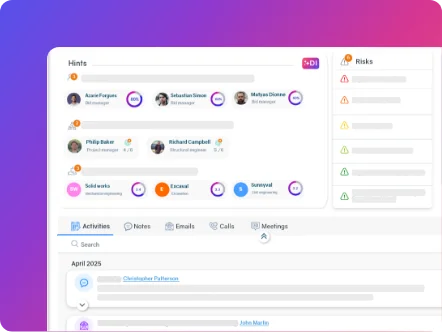
AI-powered dashboards highlight key trends instantly and turn complex project data into clear, actionable insights.
A project manager at a mid-sized engineering firm starts their Monday the same way most do: three tabs open, one spreadsheet, and a half-hour spent reconciling numbers that should already agree. The scheduling tool says one thing. The finance system says another. The field update from Friday afternoon hasn’t made it into either yet.
This isn’t a training problem or a discipline problem. It’s what happens when an engineering firm runs on disparate systems that were never built to talk to each other.
Most mid-sized architecture and engineering firms run between six and twelve separate platforms across delivery, finance, and client management, and fewer than one in five use an integrated ERP or CRM system, according to SA Global’s research on AE firm operations. Each tool was chosen in isolation to solve one problem at the time it was bought – a scheduling gap here, a reporting need there – without anyone planning for how they’d work together later.
The pattern shows up well beyond engineering. Salesforce’s Connectivity report found that organisations now run over 1,000 applications on average, and roughly 70% remain disconnected from one another. Every one of those gaps becomes someone’s manual task: re-keying a number, chasing a colleague for a status update, rebuilding a report that a connected system would have surfaced automatically.
The cost isn’t dramatic. It’s quiet and constant. Panorama Consulting’s analysis of system integration failures points to a direct line between disconnected systems and rising operational costs – not because any single tool is broken, but because every handoff between tools now needs a person to bridge it.
Standalone estimating and bid tools
Dedicated estimating software is often genuinely strong at the thing it’s built for: takeoffs, pricing libraries, subcontractor quote comparison. The trade-off is what happens next. A bid built in a standalone tool typically needs to be re-entered, exported or manually reconciled once a tender is won, which reintroduces exactly the re-keying and lost-context problem the tool was meant to solve.
Good fit if: estimating is your only pain point and your delivery systems are already well integrated separately. Watch for: how (and how well) the tool exports into whatever runs the project once you’ve won it.
Enterprise all-in-one construction platforms
Platforms such as Procore and Autodesk Construction Cloud are strong where document control matters most – drawings, RFIs, submittals, version history – and that reputation is well earned. The trade-off to check for with these platforms is how pricing scales – by contract volume, by seat, or flat – and how long rollout actually takes for a contractor your size. Ask the vendor directly and get it in writing rather than assuming a timeline or cost structure; this varies enough by contract that it’s not safe to generalise.
Good fit if: you’re managing large, complex projects with dozens of subcontractors and a dedicated administrator to run the platform. Watch for: whether the pricing model punishes growth, and whether procurement and equipment modules are core to the platform or a paid add-on.
Spreadsheets and ad hoc tools
Excel remains the most-used bid management tool in the industry, and for good reason – it’s flexible, free, and everyone already knows how to use it. The limitation shows up exactly where bid management meets delivery: pricing assumptions, scope notes and subcontractor commitments live in one person’s file, with no live link to the project once work starts.
Good fit if: bid volume is genuinely low and a single person owns the whole process end to end. Watch for: what happens to institutional knowledge when that person is on leave, or leaves the company.
Modular, bid-to-delivery platforms
A smaller category of platforms is built specifically to carry bid data through into project execution rather than treating it as a separate system. Operate is one example: bidding sits in the same platform as project execution, so a winning bid’s pricing, scope and subcontractor quotes become the starting point for the delivery budget rather than a document to be re-typed.
Good fit if: the gap between “we won the tender” and “delivery has the right numbers” is a recurring problem.
A bid is priced by an estimator, delivered by a project manager, and executed by people on site – and in many organisations, those are three different tools with three different sources of truth. Workforce management that’s genuinely connected to the bid – not a separate mobile app bolted onto the office system – is what keeps a project’s actual cost and schedule aligned with what was tendered, rather than drifting apart from week one.
This is also where professional standards bodies increasingly weigh in: the Chartered Institute of Building’s policy and research work has repeatedly flagged the disconnect between commercial teams and delivery teams as a structural risk to project outcomes, not just an IT inconvenience.

Operate Expert
Our Operate experts work specifically with AEC teams. They'll show you the parts of Operate that are relevant to how you work — and be straight with you about whether it's the right fit.
If you're evaluating software, or if you're paying for a platform your teams have stopped using, it's worth 15 minutes.
Book a discovery call →Evaluating the tool purely on how well it builds a bid, without checking what happens to that bid’s data once the tender is won. A brilliant estimating tool that requires manual re-entry into your delivery system just moves the re-keying problem downstream instead of removing it.
It depends on project complexity and in-house administrative capacity. These platforms are strong on document control and built for teams with dedicated administrators and large, complex projects. For a mid-market contractor without that overhead, the licensing model and rollout time are worth comparing carefully against more modular alternatives before committing.
Automation earns its keep on repeated tasks – pulling historical pricing, generating RFQs, reconciling subcontractor quotes – so the benefit scales with bid volume. At very low volume, the case is weaker, and a well-organised spreadsheet may genuinely be the more practical choice for now.
Ask to see a won bid actually appear inside the project delivery module, with the original pricing and scope intact, not just referenced in a linked document. If that step requires manual export or re-entry, the “integration” is closer to a file transfer than a connected workflow.
It’s a reasonable factor to weigh, not a deciding one. Public sector work under frameworks like the Construction Playbook places real weight on continuity from commercial assessment through to delivery, which rewards tools built around that connection – but plenty of good private-sector tools support the same continuity without being built specifically around public procurement.



Start simplifying your projects, aligning your teams, and making smarter decisions today.