
Why Contractors Are Rethinking Their Construction Software Bill in 2026
Curious what pricing actually looks like in 2026? See how the model works, and what a per-user alternative that deploys...
Read More → 
AI-powered dashboards highlight key trends instantly and turn complex project data into clear, actionable insights.
Request a demo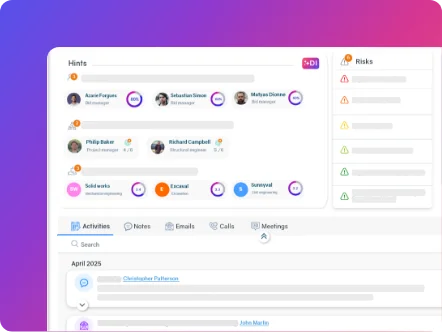
AI-powered dashboards highlight key trends instantly and turn complex project data into clear, actionable insights.

AI-powered dashboards highlight key trends instantly and turn complex project data into clear, actionable insights.
Request a demoAI-powered dashboards highlight key trends instantly and turn complex project data into clear, actionable insights.
There’s a cake in the break room. A card everyone signed, even the people who barely worked with him. A few speeches. A few laughs.
And then Alain walks out the door, and with him: 30-plus years of knowing exactly how to sequence a difficult phase, which subcontractor combinations cause delays, which shortcuts actually hold up on-site, and which “obvious” fix has quietly failed three times before.
None of that was written down. It didn’t need to be. Alain was the procedure manual. Ask him a question, get the answer. That’s how it worked for three decades, right up until it didn’t.
This is not a story about one retirement. It’s the story the construction industry is about to live through at scale.
Everyone talks about the construction labor shortage. Fewer people talk about what’s actually leaving with it.
The numbers are hard to ignore:
New hires can be trained on codes, tools, and safety procedures in a classroom. What they can’t get from a classroom is the thing that took Alain 30 years to build: the judgment. The pattern recognition. The “I’ve seen this exact problem before, and here’s what actually works” instinct that only comes from having lived through the job going sideways a few times.
Industry analysts have started calling this a knowledge cliff rather than a labor shortage, because hiring more people doesn’t solve it. You can post a job for a project manager. You cannot post a job for someone with Alain’s specific 30 years.
Ask most construction firms where their institutional knowledge lives, and the honest answer is: in a handful of people’s heads, scattered across decades of emails, meeting notes, punch lists, and site photos nobody’s indexed.
It’s not that companies don’t value that knowledge. It’s that capturing it has always meant one of two options, both of which fail quietly:
Neither scales. Neither survives a Friday afternoon retirement party. And neither captures the specific thing that matters most: not what the expert says when asked directly, but what they’d say when a real problem shows up on a real job.
Before Alain retired, he worked with his team to build something more durable than a handover document: an AI agent inside Operate, trained on his own documents, emails, and decades of project history.
The point wasn’t to write down everything Alain knows. That was never really possible. The point was to build something project teams could actually ask, the way they used to ask Alain himself. A tricky sequencing decision on a difficult phase. A subcontractor combination that’s caused problems before. A “we tried this last time and it didn’t work” gut check.
Instead of a knowledge base someone has to search and interpret, it’s a conversation, the same way getting an answer from Alain always was.
For a project team hitting a wall mid-build, the difference is concrete:
That last point matters most. Most institutional knowledge gets consulted only in hindsight, during a postmortem, once the mistake has already been made. An AI agent trained on someone’s actual experience can be consulted before the decision, which is the only point at which it can actually prevent the mistake.
No, and the distinction is worth being precise about. Documentation captures what someone did. It rarely captures why they’d do it differently next time, or the judgment calls that never made it into a report because they felt too obvious to write down at the time.
An agent built on someone’s real project history, emails, and decisions can hold onto that judgment in a form future teams can actually query, not read, query. That’s the difference between a manual sitting in a folder and a resource someone actually reaches for on a Tuesday afternoon when a job is going wrong.

Operate Expert
Our Operate experts work specifically with AEC teams. They'll show you the parts of Operate that are relevant to how you work — and be straight with you about whether it's the right fit.
If you're evaluating software, or if you're paying for a platform your teams have stopped using, it's worth 15 minutes.
Book a discovery call →It’s the process of preserving the practical, experience-based judgment of long-tenured staff, including sequencing decisions, lessons from past project issues, and site-specific problem-solving, so it doesn’t leave the company when that person retires or moves on.
Because new hires can be trained on standard procedures, but they can’t inherit judgment built over decades on real jobs. With roughly 41% of the U.S. construction workforce projected to retire by 2031, firms are losing decision-making experience faster than it can be replaced through hiring alone.
No. An AI agent built on someone’s documented experience is a reference, a way for teams to ask “what would this expert do” and get a grounded answer. It doesn’t replace judgment on-site; it extends access to judgment that would otherwise have retired.
Operate AI is trained on a company’s own project documents, emails, and history, including a retiring team member’s own records, so future teams can query specific, experience-based answers instead of searching through years of disconnected files.



They’re still on the job, one question at a time. See how Operate AI helps AEC companies capture institutional knowledge before it walks out the door.